Home Guides and Articles
Can RTV Sealant Help The Performance Of Your Direct Vent Fireplace

Can RTV Sealant Help The Performance Of Your Direct Vent Fireplace

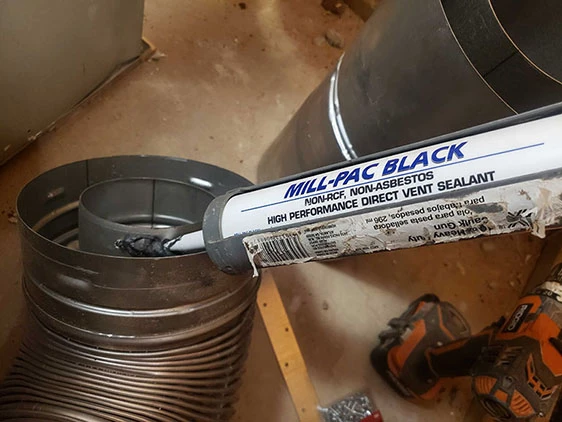
If you have a direct vent fireplace with poor performance quality; like low flames, excess soot or random flame outage; you may have missed a critical component during installation. Mill Pac is a brand of high-temperature sealant, similar to a silicone sealant, that is applied to venting for direct vent fireplaces.

It helps to seal connections or any other places where air may leak out. Mill Pac is a widely used and trusted brand of sealant because it has a less rubbery consistency and higher temperature rating than many others.

Though it is very important to use a RTV sealant, or fire caulk as some call it, you could opt for Rutland Seal It Right, as a more affordable but still quality alternative. The most important thing to understand is that if the fire caulk was not applied at the original installation, you may end up with gas leaking from the exhaust pipe into the intake air pipe. If that leak is bad enough, it can be the culprit behind your poor fireplace performance.
Can RTV Sealant Help The Performance Of Your Direct Vent Fireplace

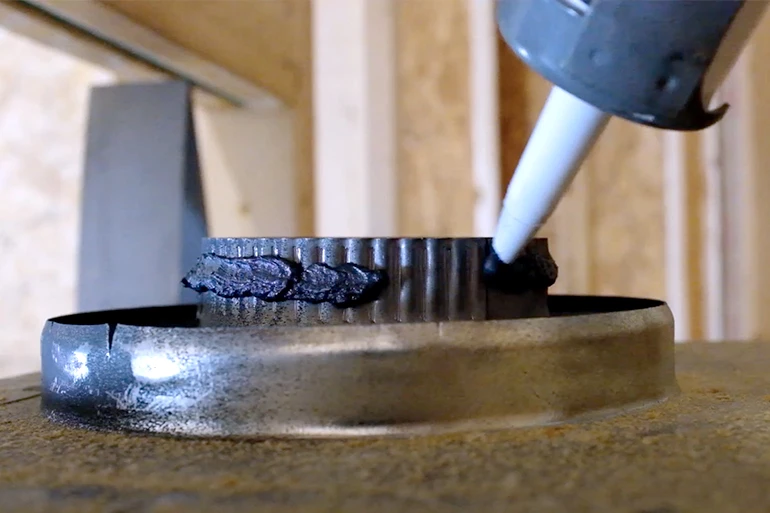
It's absolutely necessary for the sealant to be applied at the flue collar and anywhere flex vent pipe meets a stationary piece of pipe. If you are joining flex piping to a rigid coupler or transitioning to a rigid section through the roof or wall, its suggested to use the sealant to make sure the flex pipe doesnt lose its grip.

About the Author

Collin Champagne

With over 13 years in the industry, Collin is a National Fireplace Institute (NFI) certified technician and managed content for the eFireplacestore and eCanopy brands. He has achieved the highest NFI certification possible as a Master Hearth Professional and is certified in all three hearth appliance fields: wood, gas, and pellet. With experience with sales and in-field installations, his expertise shines through his technical knowledge and way with words.

Customer Q&A with Product Specialists

Rick P. from 3123 Caroline CrescentSuffolk, VA 23435 asked:
Hi! While working on the siding, a hammer hit my gas fireplace and broke one of the interior tiles into several pieces. I found a new piece that needs to be cut to size (6 x 11), but I'm unsure what adhesive to use. The existing tiles appear to be butted together without any gaps, so the adhesive will need to support the full weight of the tile. I'd prefer to use a pre-mixed compound if possible, as I struggle to differentiate between loose, stiff, and peanut butter consistencies. Could you please provide guidance and any helpful tips for a novice like myself? Thank you! Respectfully, Richard
The brick-look tiles that line the inside of a gas direct vent firebox are not designed to be glued in place. For these fireplaces, the interior liner panels are secured by the firebox and its retaining clips. They are engineered to expand and contract with temperature changes. Bonding a panel or tile in a fixed position with adhesive prevents this necessary movement and typically causes it to crack. For this reason, we do not use RTV sealant, high-temperature silicone, refractory cement, or mortar to fasten liner pieces inside a gas firebox. We also do not recommend cutting a generic replacement piece to size and adhering it in a gas unit. A liner panel that has broken into pieces should be replaced with the correct factory part made specifically for your model, rather than glued back together, as this is the safe repair. If you can provide the make and model of your fireplace along with your shipping zip code, I can check replacement liner panel availability through our distributor network and provide a quote. The model information is usually printed on the rating or data plate, often located behind the lower louver or inside the control access area. To clarify regarding the article you viewed: RTV and Mill Pac sealant are used to seal the joints of direct vent PIPE, not to bond the decorative tiles inside the firebox, so they are not the appropriate products for this repair.
Answered by: Tyler M. on Jul 20, 2026

Helpful?

0
Showing 1 of 1 Questions and Answers
Ask a Question
chat-bot-icon