Free shipping offer is valid only on specially marked items.
Free shipping offer does not include any other items included in the order unless they are valid for the free shipping offer.
Budget Shipping method will be selected by eFireplaceStore.com for the free shipping offer (most commonly UPS ground). Overnight, 2nd Day Air, & 3 day select methods are not available for free shipping.
Free shipping offer is not available for orders to HI, AK, PR, or international orders.
This offer is for a limited time only. eFireplaceStore.com reserves the right to end or change this free shipping offer at any time.
110% Low Price Offer
eFireplaceStore offers low prices on everything we carry. If you should find a lower price from a legitimate competitor on an identical item we stock (including shipping, tax, etc), we will beat the competitor's price by 10% of the difference!
Please fill out the form below to find out if you qualify for the discount. In most cases you will receive a response within 1 business day. See below for complete details.
Our Price Match Policy
If you find a product on a competitor's website where their total price with shipping and sales tax is lower than our total price, we will gladly beat it by 10% of the difference in price!
The product(s) must have a verifiable online advertised price. This offer is not valid with the use of any coupon from eFireplaceStore. This policy excludes closeouts, liquidations, store specific coupons or rebates, and clearance items. eFireplaceStore will not price match orders placed previously or already received. We do not match local stores or ads, local pick-ups, auction sites (e.g. ebay), or wholesale club prices in which there is a fee to join, such as BJ's Wholesale, Costco Wholesale, & Sam's Club Wholesale. The competitor must have the item in stock and available for immediate shipping to qualify. We must be able to calculate their total with shipping and sales tax on their website—we will not call them for special quotes on items or freight and will not price match to an email quote.
We understand and share your concern about security and privacy. It is reassuring to know that it is statistically safer to use your credit card on the web than to use it in a store or restaurant. The information that you provide when placing an order with us (e.g. your name, address, and credit card information) is secure. It cannot be read or tampered with during transmission.
Our checkout process uses industry standard TLS (Transport Layer Security) technology to encrypt and scramble all personal information including your name, address, and credit card information so that it may not be read by others as it travels over the Internet. TLS encryption is employed during checkout when the URL in browsers, such as Google Chrome or Mozilla Firefox, changes from "http" to "https". The "s" indicates that you are in a secure area. Your browser may also show a pop-up window when you are here.
For your security, we authorize your credit card after we obtain confirmation that your card is a valid number and has not been reported lost or stolen. We also verify that the "Bill To" address matches the address on the credit card used. It is not uncommon for a request for credit card authorization to fail at times. We will contact you if we experience such difficulties and you may wish to provide another credit card.
Email is not encrypted so please do not transmit your credit card number via e-mail.
Under the Fair Credit Billing Act, the maximum amount that your bank can require you pay for any fraudulent charge on your credit card is up to $50. Notify your credit card company immediately should you ever suspect a fraudulent charge on your credit card as you would for any other unauthorized charge.
eFireplaceStore Privacy Policy
We will never sell, trade, or rent any customer or gift recipient e-mail address or personal information to any third party. Nor will we share this information with any third party except to the extent necessary to fulfill an order or when the outside party is strictly acting on our behalf with no independent right to use the information we provide. We may provide aggregate statistics about our customers, sales, traffic patterns, and related site information to certain reputable third party vendors but these statistics will not include any identifying personal information. We may disclose personal information in the event that if we are required by law however. Accordingly, you authorize us to disclose any and all information about you to law enforcement or other governmental official as we deem necessary or appropriate with any investigation of fraud, intellectual property infringements, piracy, or other unlawful activity that is illegal and that may expose us to legal liability.
Our order form collects customer contact information such as name, address, e-mail address, telephone number, and credit card financial information needed to process and bill an order. We take numerous precautions to protect customer information and the sensitive information that is submitted to us is protected both online and offline.
The contact information is necessary to personalize and send information about orders to our customers, to fulfill and notify you of delivery, and to get in touch with you if necessary for customer service or questions about an order. We may also use customer information and the Internet Protocol (IP) address used to connect your computer to the Internet to improve the content of our site, to improve your shopping experience, and for marketing and promotional purposes.
We also collect contact information about gift recipients to ensure correct gift delivery. We may send special offers and information about new items or features to our valued customers and gift recipients from time to time. The recipient may always opt out of receiving future mailings.
Customers may join our mailing list by choosing to register on our home page or during the checkout process. You can contact us to unsubscribe and we will remove your name and e-mail address from any future mailings. A page of our site is forwarded to the specified e-mail recipient only when you use the Refer-a-Friend feature on our site.
eFireplaceStore.com uses cookies to facilitate the checkout process. You may still make purchases at our site if you have set your browser to disable cookies but functionality may be limited.
eFireplaceStore.com reserves the right to refuse a sale at any time for any reason.
I tried to remove some old vent pipes that went into my basement. White, sandy material came out from the vent pipe. Is this material harmful?
That material should just be a silica sand and is not harmful.
Answered by:
Aaron D.
Helpful?
20
Marc S. from Hendersonville NC asked:
Question: I have a MFG fire place with a veneer stone face and metal flue pipe. I want to put my wood stove in front of the fire place,go through the wall and connect my wood stove pipe into the existing metal flue pipe. Would there be any problem with do
If the existing pipe is a Class A pipe approved for venting a wood stove, you could do that but most factory-built fireplaces require you to vent using their specific pipe. If that is the case, then that pipe is not approved for venting a wood stove.
Answered by:
Kathy O.
Helpful?
10
Mike K. from East of New York city asked:
I have a Vermont Castings Acclaim stove in my basement that vents to a chimney approximately 34 feet high using 6-inch pipe. There have been no previous venting issues. During a recent chimney cleaning, about half a cup of sand was found. The chimney cleaner suggested the sand indicates deteriorating mortar joints, potentially due to a cracked liner from running the stove very hot. I'm considering installing a stainless steel liner – should it be double or single-walled? Are there specific brands recommended for Vermont Castings stoves, and what thickness should the liner be? The chimney has been in use for 20 years with no leaks, only this sand. Could the cleaner be exaggerating the issue to push a liner installation?
Hi Mike,
Thank you for reaching out regarding your Vermont Castings Acclaim stove and your chimney concerns. Please note that we are not a Vermont Castings dealer and cannot provide specific product recommendations or compatibility assurances for their stoves. However, we can guide you on stainless steel chimney liners for wood-burning appliances.
The presence of sand during a chimney cleaning could indicate deterioration of your masonry. A chimney liner is designed to protect the masonry from the damaging effects of flue gases and ensure safe, efficient venting. We recommend obtaining a second opinion from another certified chimney professional to confirm the diagnosis and the necessity of a liner, as we cannot provide an assessment of your chimney's condition or your cleaner's recommendations.
Regarding stainless steel liners, we offer options from DuraVent, a reputable brand for relining systems:
* **DuraLiner:** This is a high-temperature, insulated double-wall masonry relining system suitable for wood-burning appliances. It features a .016" 304 stainless steel inner liner for rigid pipe and .005" 304 alloy stainless steel construction for flexible pipe options. A key benefit of DuraLiner is its zero clearance rating between the liner and masonry, and masonry and combustibles, which can be crucial for high-heat wood-burning applications.
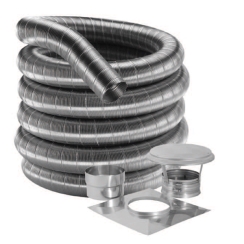
* **DuraFlex Stainless Steel (SS):** These are flexible stainless steel liners, available in single-wall options like the 316 and 304 types, which are economical and good for wood-burning appliances. The DuraFlex SW type is specifically ideal for wood and gas-burning units and has a smooth inner wall to reduce creosote buildup. The DuraFlex SS liners typically have a .006" metal thickness.
For your 6-inch pipe requirement, both single-wall DuraFlex SS and double-wall DuraLiner are available. The choice between a single or double-wall liner often depends on your specific installation requirements, clearances to combustibles within the chimney chase, and local building codes. An insulated double-wall liner like DuraLiner offers enhanced safety and performance, especially with 0" clearance to masonry and combustibles.
It is crucial to consult your Vermont Castings Acclaim stove's installation manual for any specific venting restrictions or requirements. Additionally, always follow local building codes and have your venting system inspected by a certified professional.
We have various 6-inch DuraVent stainless steel liners that could be suitable for your application. For example, we carry:
* DuraFlex SS Stainless Steel Chimney Liner - 6 inch x 20-ft. - 6DF316-20
* DuraFlex SS Stainless Steel Chimney Liner - 6 inch x 25-ft. - 6DF316-25
* DuraDuroVent DuraLiner 48 inch Round Rigid Reline Pipe - 6 inch Diameter - 6DLR-48
* DuraVent DuraLiner 36 inch Round Flex Reline Pipe - 6 inch Diameter - 6DLR-36F
To help us provide a more tailored recommendation and a quote, could you please confirm the exact model number of your Vermont Castings Acclaim stove? Also, please provide your shipping zip code so we can calculate pricing and lead times.
Answered by:
Tyler M.
on May 01, 2026
Helpful?
00
Robert M. from Swan Lake, Montana asked:
What diameter should the female dimension of a steel coupling flange be to receive the male end of a 6 inch and/or an 8-inch stove pipe?
If you are referring to the flue connection on a wood stove, there is no general answer we would be able to provide. I will note, however, that most stovepipe manufacturers will offer a stovepipe to appliance adapter to provide the proper male end down connection by accounting for slight differences between the female stove flue connection and the male connection of the stovepipe.
Answered by:
Will M.
Helpful?
00
Dwayne R. from Winter Park FL asked:
I am looking for a 10 x 15 flue mount chimney cap. Where might I find that?
Stephen F. from Berkeley Springs, W.V. 25411 asked:
I need a super vent chimney pipe to reduce from 8" to 6". Where can I buy one?
Unfortunately, Supervent does not have an adapter to go from 8" - 6".
Answered by:
Aaron D.
Helpful?
00
Karl G. from Mont Vernon NH asked:
Do you sell a reducer for an insulated pipe from 7 inches to 6 inches?
No, our only such reducers are for the single-wall black stovepipe.
Answered by:
Tyler M. - NFI Master Hearth Professional
Helpful?
00
William R. from virginia asked:
Do you sell stainless steel chimney pipe?
Yes, we have several brands of chimney pipe. Some are used with specific units.
Answered by:
Kathy O.
Helpful?
00
Brent asked:
I want to remove an old fireplace and install a zero clearance fireplace. There is currently an 8" chimney/flue exiting the chase above the roof. Can a fireplace that requires a 6" flue be installed with a flexliner 6" inside the existing 8" pipe?
No, you will need to connect all-new pipe that is compatible with the new fireplace model, as this is the only way to get a proper, listed installation. The diameter/model of the chimney pipe needed will be determined by the model itself.
Answered by:
Tyler M. - NFI Master Hearth Professional
Helpful?
00
Bruce F. from West Tisbury, Mass asked:
Do you sell a flue paint sealer?
No, we do not offer this product.
Answered by:
Will M.
Helpful?
00
Glenn from Berlin NJ asked:
I have a 42" TemTex woodburning fireplace and need the flue pipe to install, do you have this?
No, we apologize, but we do not have any chimney parts for Temtex fireplaces.
Answered by:
Owen O.
Helpful?
00
Jeff from baldwin WI asked:
I am looking at the WRT4542 for my 1200 sq. ft. home. My question is, will the damper in the stove leak cold air when not fired? Also, will a vent kit do the same? Additionally, do I need a fresh air kit?
The WRT4542 fireplace has a fireplace built into the top of the unit and this will do a great job preventing too much cold air intrusion down the flue and into the house. You could also add glass doors to this unit to further mitigate any such cold air issues. There is no fresh air kit needed for the chimney, as the pipe itself is air-cooled with a 15-inch outside diameter pipe (it has a 12-3/8-inch inside diameter). We would recommend a fresh air kit to be connected to the side of the fireplace if it will be installed near an exterior wall or above crawlspace.
Answered by:
Tyler M. - NFI Master Hearth Professional
Helpful?
00
Milo from Camp Wood, TX asked:
My ceiling is 10 ft high. What do I need for support in the chase?
On the vertical rise within the chase, it is recommended to have wall straps for support every 8 feet.
Answered by:
Tyler M. - NFI Master Hearth Professional
Helpful?
00
Ron B. from Oroville,CA asked:
How do i get an airtight seal from my insert to chimney without installing pipe all the way up the existing brick chimney?
Helpful?
00
Michael from Hickory, NC asked:
When using an oval liner, should the adapter be sized so that the liner fits over the adapter or inside of the adapter?
When using sleeves and adapters, the male end of the liner should always be facing back towards the unit. This allows condensation to run back inside of the appliance as opposed to down the exterior of the liner itself.
Answered by:
Chris
Helpful?
00
Craig from Hamilton asked:
How long does a gas liner last?
While longevity will depend on the amount or humidity in the flue gases, the typical liner can last for 20 to 25 years under normal conditions. In extreme circumstances where high humidity is present, the life expectancy can be cut in half.
Answered by:
Collin C. - NFI Master Hearth Professional
Helpful?
00
Pete from Indianapolis, IN asked:
Should inner liner go inside outlet on box or should it be outside?
The general rule of thumb is for vent pipe to be installed male end down. So, the liner would go inside the flue outlet. Of course, most factory boxes require specific brands of pipe that feature locking tabs and ensure a proper fit/connection.
Thank you for your interest in our products. We've received your question and will get back to you shortly — usually within the hour but always within 1 business day. To ensure you receive our response, please add our email address (info@efireplacestore.com) to your email whitelist or address book.
In the meantime, while we prepare our response, keep an eye on your inbox for an email from us. We'll be sending you our exclusive Buyer's Guide, packed with valuable information to assist you in making the best decision for your needs.
If you have any further questions or need immediate assistance, feel free to reach out to us directly at 1-800-203-1642.
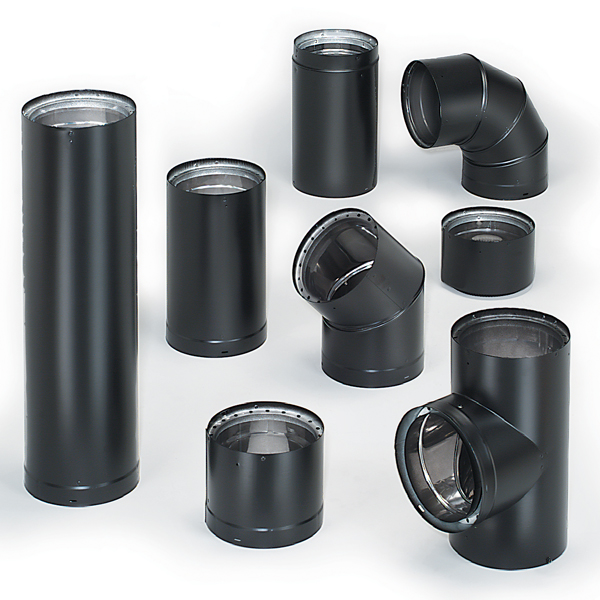
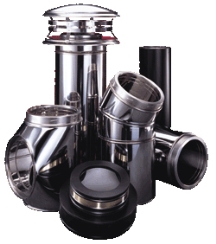
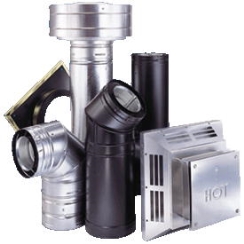
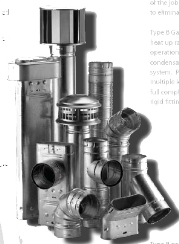
When installing a vented fireplace, the fireplace itself is only half of the equation. You've got the fireplace flue, the chimney pipe also called the flue pipe, and more to deal with. Every vented fireplace uses a specific type of chimney pipe or vent pipe to safely pass combustion gasses to the outdoors.
Spend any time looking at the plethora of venting products on the market and you may find your head spinning a bit. To cut down on the amount of confusion when it comes to fireplace flue pipe, we have created a handy buyer's guide that gives a step-by-step look at what vent system you need for each fireplace. Armed with the knowledge from this Chimney Pipe Buyers Guide, you are sure to find what you need.